Toddler Food Games
Healthy Food Game for Toddlers: How Snack Spinner Makes Trying Food Feel Playful
A parent-friendly guide to using Snack Spinner as a healthy food game for toddlers, with spins, Bear lessons, plates, treats, and progress reports.
Updated 2026-06-23 · 5 min read
Why toddlers respond to food as play
Toddlers are often more willing to explore when the task feels like a game instead of a demand. A bright wheel, a friendly character, and a clear little goal can make a new food feel less like pressure and more like discovery.
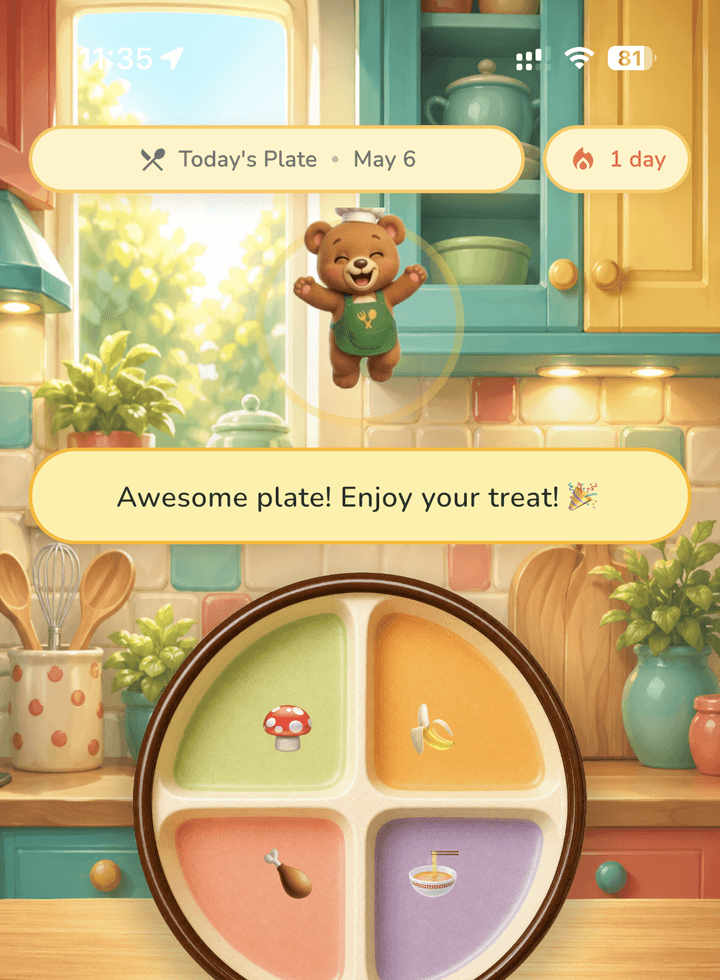
Snack Spinner uses that idea directly. Children spin food groups, choose real foods, hear Bear name them, and build a daily plate one small choice at a time.
What Snack Spinner actually does
The core loop is simple: spin, pick, learn, add to the plate, and celebrate. Fruits, vegetables, proteins, grains, and treats each become part of a routine that a young child can understand without reading.
Bear adds voice and tiny food facts so the app is not only a random spinner. It gives children repeated exposure to food names, categories, colors, and meal-building patterns.
- Food wheels make choosing visible and tactile.
- The daily plate gives each session a clear finish line.
- Treats are framed as part of a balanced loop, not the whole reward.
- Parent reports show what was planned, picked, and eaten.
Where it helps parents
Snack Spinner is not a meal plan, a medical tool, or a promise that every child will suddenly eat everything. Its value is smaller and more practical: it gives parents a playful way to talk about food before the plate becomes a battle.
That matters most for repeated exposure. Seeing a food, hearing its name, choosing it, and placing it on a plate can make the next real-life bite feel a little more familiar.
How the app supports healthy food routines
Healthy eating habits are easier to discuss when the categories are concrete. Snack Spinner gives children a friendly structure for fruits, vegetables, proteins, grains, and treats without turning the experience into a lecture.
The parent side keeps the routine grounded. Reports and grocery ideas help adults see patterns without forcing the child-facing experience to become complicated.
| Snack Spinner feature | What the child experiences | Why it can help |
|---|---|---|
| Food wheel | A colorful spin and choice | Makes food categories feel active and approachable |
| Bear lessons | Food names and tiny facts | Builds familiarity through repetition |
| Daily plate | A visible meal-building goal | Turns scattered choices into a simple routine |
| Parent report | Invisible to the child | Helps parents notice patterns and follow up offline |
Why it is a good fit for iPhone and Android
A toddler food game needs to be quick, readable, and easy to repeat. Snack Spinner works well on phones because the interactions are large, visual, and short enough for a kitchen counter, grocery conversation, or calm moment before lunch.
Parents can download Snack Spinner on the App Store or Google Play when they want a food-learning app that feels more like a small shared ritual than a worksheet.
FAQ
Is Snack Spinner a picky eater app?
Snack Spinner can support picky eater routines by making food names and categories more familiar, but it is not a medical or feeding therapy tool. It works best as a playful companion to parent-led meals and repeated exposure.
Does Snack Spinner have ads or a subscription?
Snack Spinner is designed as a parent-friendly app with no ads and no subscription. Purchase flows stay parent-gated.
Download Snack Spinner
Spin, choose, learn, and build a healthy food routine with Bear on iPhone, iPad, and Android.